
The Rising Tide of Dubai’s Housing Market
Population Growth Boosting Housing Demand
Dubai, known for its stunning skyline and opulent lifestyle, is experiencing a significant surge in demand for housing. The latest Real Estate Outlook from ValuStrat sheds light on this dynamic landscape, projecting that a growing population and heightened interest in residential properties will continue to place pressure on the market. By March 2025, the population of Dubai had ballooned to 3.92 million, with nearly 90,000 new residents moving to the city in just the first quarter of the year—a striking average of around 1,000 new residents daily. This influx stands in stark contrast to the net population increase of fewer than 500 people per day in 2024.
Housing Supply Struggling to Keep Up
Given this escalating demand, it’s no surprise that the estimated number of new homes expected to be delivered in 2025 stands at a hefty 61,580 units. However, the challenge is clear: securing an affordable place to either buy or rent is becoming increasingly difficult. Haider Tuaima, Managing Director & Head of Real Estate Research at ValuStrat, notes this growing challenge, emphasizing that the pace of new builds must accelerate to alleviate these pressures.
Investment in Luxury Living
Luxury living is becoming a key draw for high-net-worth individuals looking to relocate to Dubai. A recent study indicates that these affluent newcomers are projected to spend around $44 billion on Dubai’s luxury homes. This opportunity not only caters to a market seeking exclusivity but also accelerates the overall demand for premium real estate, further straining the existing supply.

The Price of Luxury: Record Increases
Pricing trends in Dubai’s residential sector illustrate the impact of this demand surge. The ValuStrat Price Index (VPI) reveals that apartment prices have risen by an astounding 21.4% since Q1 2021, while villa prices have seen an even more dramatic increase of 30.3%. Specific locales have experienced particularly steep gains; for example, areas like Jumeirah Islands and Palm Jumeirah have seen price increases of 42% and 41%, respectively.
With rental rates mirroring this trend, villa rents have surged by 5.1%, and apartment rents have increased by 10%. The average annual rent for a one-bedroom apartment currently hovers around AED 90,000, while three-bedroom apartments are leasing at approximately AED 192,000. Villa rents range even higher, with averages between AED 336,000 for three-bedroom units to AED 519,000 for five-bedroom properties.

Signs of Market Adjustment
Interestingly, despite the ongoing demand, recent trends indicate potential signs of a market adjustment. There has been a noted decline in residential sales—both off-plan and ready properties—alongside a decrease in mortgage applications. This trend, while unexpected, hints at a possible mismatch between supply and demand. Analysts speculate that these developments may lead to a market correction in the near future.
New Builds on the Horizon
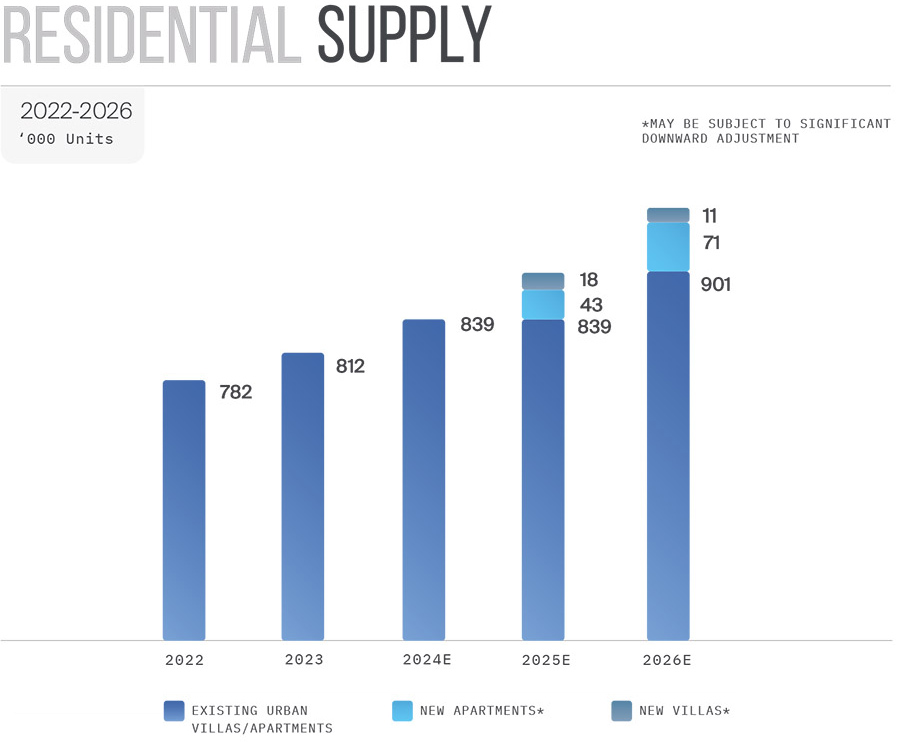
To address the rising demand, a substantial number of new residential units is slated for delivery this year. The bulk of the 61,580 expected units will be apartments, comprising about 70% of the new inventory, while the remaining 30% will be villas and townhouses. Key developments that have recently completed include Berkeley Place in MBR City, which added 127 apartments, and Torino in Arjan, with 625 houses. Notable villa communities are also entering the market, such as Pulse Beachfront Phase 1 and Bliss Townhouses Phase 1.
Looking Ahead
Dubai’s residential supply, currently around 840,000 units, is projected to approach one million by the end of 2026. Nonetheless, experts suggest that this increase in supply is still unlikely to meet the growing demand. As Tuaima articulates, “We have a rising population, but we don’t have the supply of properties to match it." With rents already having soared to levels surpassing pre-pandemic peaks, the expectation is that true equilibrium in the market may not be realized until around 2028.
In summary, the dynamic of Dubai’s housing market is both compelling and complex. As the city continues to attract new residents and investments, understanding these shifting trends becomes imperative for stakeholders navigating this vibrant landscape.

