
Moroccans Attempt Mass Crossing to Spain’s Ceuta Amid Deaths and Heightened Security
CEUTA, Spain: A significant number of Moroccans attempted a mass crossing into Spain’s Ceuta on July 31, 2026, driven by hopes of a better future. However, many were turned back due to heavy security measures, tragic fatalities, and uncertainty regarding opportunities in Europe.
When news broke that the border had been breached, Abdulah Buji, a 21-year-old aspiring teacher from northern Morocco, quickly mounted his motorbike and raced toward Ceuta. He joined tens of thousands of others attempting to swim into the small Spanish enclave in North Africa. Buji expressed his belief that this collective effort could be the key to realizing his dream of a new life in Spain.
“Spain gives you the chance to make your future, not like Morocco,” Buji stated. “I am a talented boy. I just want a chance.”
People pose for a photo as they attempt to cross from the Moroccan northern town of Fnideq to the Spanish enclave of Ceuta, Friday, July 31, 2026. (AP)
Despite his initial excitement upon reaching Spanish soil, Buji quickly faced the harsh reality that his journey was far from over. The Mediterranean Sea lay between him and mainland Europe, and Spanish authorities ordered all new arrivals to turn back or risk expulsion.
Buji narrowly escaped joining the more than 50 individuals who lost their lives attempting to reach Ceuta. Although he made it across, he lost his belongings and money during the crossing. Faced with the prospect of legal limbo and possible detention, he decided to return to Morocco.
“I’ve spent perhaps 14 years studying, but there’s nothing at home, and I’d have to work 12-hour shifts for a meager wage,” Buji explained. “That’s why I came here, but I haven’t found any opportunities here either, so I have to go back.”
A Futile Crossing
Between Thursday and Friday morning, approximately 60,000 individuals crossed into Ceuta, with around 45,000 returning to Moroccan territory within hours. Many spent the night on the streets of Ceuta, where they encountered startled locals and a heavy presence of Spanish police and military personnel.
This massive influx represented about 70% of Ceuta’s resident population, prompting local authorities to call for increased police and military presence to restore order. Residents expressed concern over the sight of thousands of young men wandering the streets.
Ceuta’s residents recalled a similar but smaller migration crisis in 2021 when the Moroccan government relaxed border controls, allowing several thousand migrants from Morocco and sub-Saharan countries to enter Ceuta. The current situation has escalated into a much larger humanitarian crisis.
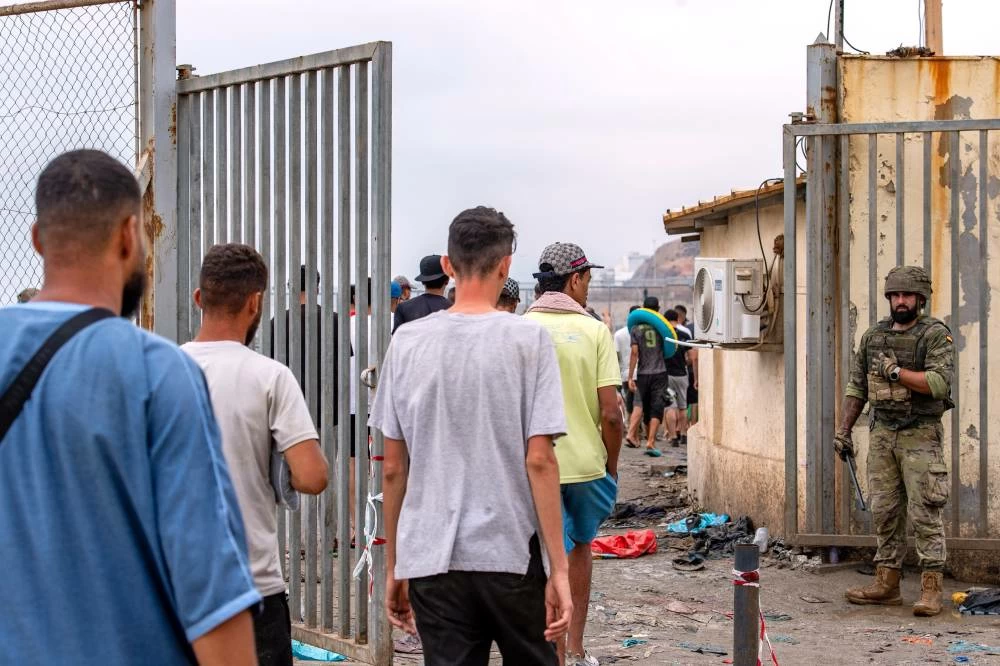
Migrants return to Morocco from the Spanish enclave of Ceuta, Friday, July 31, 2026. (AP)
As reports and videos of migrants reaching Ceuta circulated on social media, more individuals began heading north in hopes of entering European Union territory. Train stations in Morocco’s capital, Rabat, and the largest city, Casablanca, became crowded with people attempting to travel to the Ceuta border. Local media reported police officers preventing some from boarding trains and buses.
The exact trigger for this influx remains unclear. However, social media was filled with posts encouraging Moroccans to try entering Ceuta days before the mass crossing began. Myriam Cherti, a senior researcher at the University of Oxford’s Centre on Migration, Policy and Society, noted that these posts included practical advice on how to cross the border and what migrants should say to improve their chances of being allowed to stay.
Cherti indicated that some migrants she interviewed had lost track of how many times they had attempted to cross the border.
“They’re doing it out of despair, they’re doing it because they’ve tried other ways to build a life and failed, they’re doing it because they feel the obligation that they want to help their families and support them,” she said. “And that’s possible if they make it to Spain and not necessarily possible if they stay in Morocco.”
Ahmed Karim, 33, was among those who successfully crossed into Ceuta. He reported that many Moroccans face significant barriers to traveling outside the country, which compounds their challenges.

Belongings left behind by migrants float in the sea after they crossed from Morocco into the Spanish enclave of Ceuta, Friday, July 31, 2026. (AP)
Karim noted that many Moroccans aspire to reach Europe or America, but lack the necessary opportunities.
Others who crossed the border were not seeking to stay; they were searching for lost loved ones, hoping they were not among the deceased.
Ikrra Khai, 33, is one of many Moroccan women who regularly obtain temporary work permits to labor on Spanish farms during harvest season. On that day, she was in Ceuta searching for the brother of a close friend.
“I don’t know if he is dead or alive,” she stated. “I have his residency card. But I don’t know where he is. I’m searching.”
Source: www.emirates247.com
Read all the latest developments and breaking updates in the Latest News section.
Published on 2026-08-01 11:18:00 • By the Editorial Desk

