
US Supreme Court Strengthens Trump’s Immigration Agenda, Eases Deportations and Green Card Removals
WASHINGTON: The U.S. Supreme Court has recently facilitated the removal of lawful permanent residents, commonly known as green-card holders, as part of a broader trend under President Donald Trump’s administration. Since his return to office last year, Trump has pledged to intensify immigration enforcement and pursue mass deportation policies, a move largely supported by the court’s conservative majority.
In a series of decisions, the Supreme Court, which holds a 6-3 conservative majority, has largely endorsed Trump’s immigration policies, affecting both legal and undocumented immigrants. The three liberal justices have consistently opposed these measures. This week, the court delivered three significant rulings that further ease the deportation process and restrict entry for individuals, including those with legal status in the United States.
Elora Mukherjee, director of the Immigrants’ Rights Clinic at Columbia Law School, criticized the administration’s approach, stating that it has transformed the immigration system into a “deportation machine.” She noted that the Supreme Court has frequently acted as a “rubber stamp” for Trump’s mass deportation agenda.
In a notable 6-3 ruling on Thursday, the court allowed the administration to revoke Temporary Protected Status (TPS) for hundreds of thousands of Haitian and Syrian immigrants. TPS is a humanitarian designation that permits migrants from countries experiencing conflict or disaster to live and work in the U.S. while it remains unsafe for them to return.
People hold placards during a rally with immigration advocates, following the Supreme Court ruling on TPS protections for Haitian and Syrian migrants in New York City, June 25, 2026. REUTERS
Legal experts have expressed concern about the implications of this decision. Immigrants losing their TPS status now face the difficult choice of risking detention in the U.S. or returning to countries deemed unsafe by the U.S. State Department due to rampant violence and crime. Tirana Hassan, CEO of Doctors Without Borders USA, emphasized that these conditions are not suitable for return.
Ahilan Arulanantham, an immigration law expert at UCLA, remarked that the Supreme Court has consistently ruled against immigrant rights in recent years, and this case aligns with that trend. He noted that the ruling represents a significant victory for the administration and the far-right anti-immigrant movement, which has struggled to achieve similar outcomes through Congress.
The court’s rulings also included a decision supporting the government’s authority to deny entry to asylum seekers when U.S.-Mexico border crossings are deemed excessive. This policy, known as “metering,” may be revived by the Trump administration after being discontinued by President Joe Biden.
On Tuesday, the court ruled 6-3 to simplify the process for removing lawful permanent residents. The ruling allows border agents to deny re-entry to green-card holders without needing to meet the previously required standard of “clear and convincing evidence” of criminal activity.
‘The Rule of Law’
Department of Homeland Security General Counsel James Percival described the recent rulings as victories for “the rule of law and common sense.” He argued that Temporary Protected Status was always intended to be temporary. Percival stated that these decisions provide the administration with additional tools to enhance border security.
Since Trump’s return to office in January 2025, the Supreme Court has largely aligned with his policies, facilitating deportations that lower courts had previously blocked. These decisions have often been made through the court’s emergency “shadow docket,” allowing for significant rulings without extensive deliberation.
The court has permitted the administration to deport migrants to countries where they have no connections, conduct aggressive immigration raids, and terminate humanitarian protections, including TPS and other forms of relief for numerous immigrants.
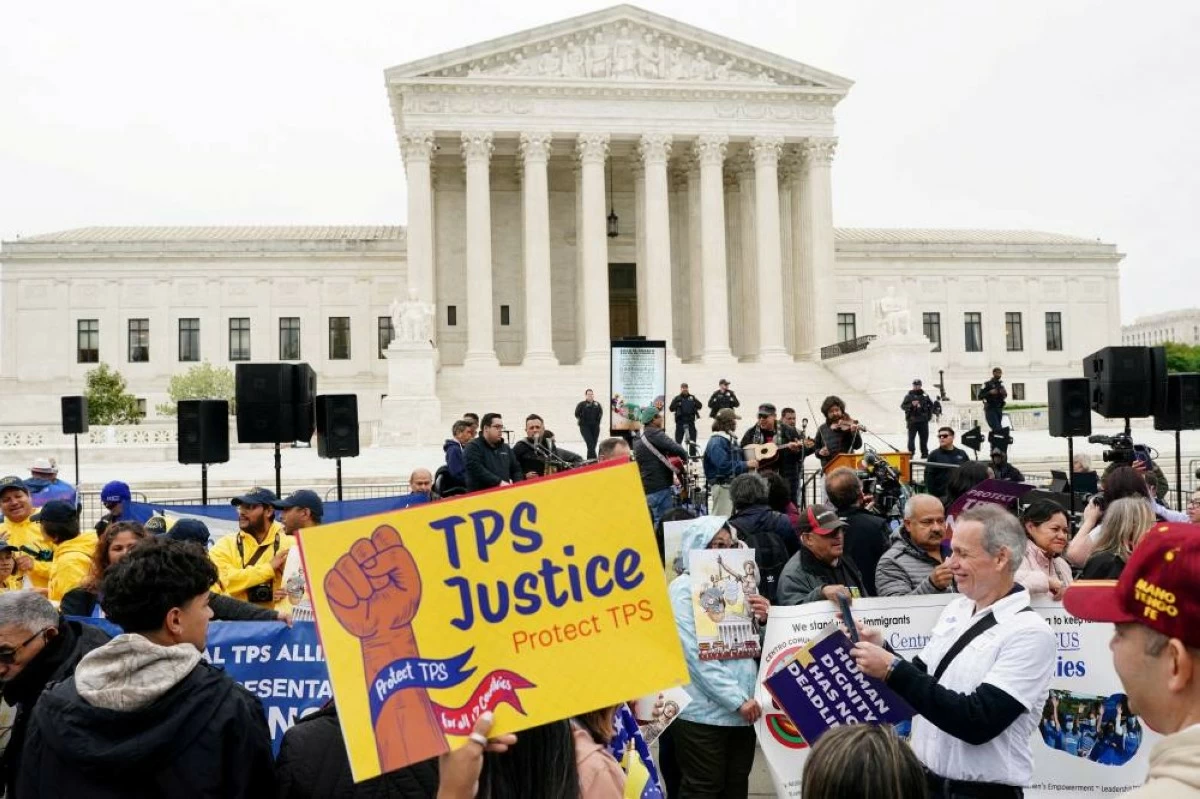
Activists rally outside the U.S. Supreme Court as justices consider arguments regarding TPS for Syrian and Haitian nationals in Washington, D.C., April 29, 2026. REUTERS
Ashley Sanchez, director of the Immigration Clinic at the University of Notre Dame, noted that while immigration laws remain unchanged, the Trump administration is applying them in ways that significantly limit both legal and illegal immigration.
The current conservative majority on the court has been in place since October 2020, following the appointment of Justice Amy Coney Barrett. This ideological shift has been crucial in shaping immigration rulings. Sanchez observed that the current court appears more inclined to support the president’s agenda compared to previous justices.
The court has occasionally pushed back against Trump, ruling that the administration must uphold the constitutional rights of migrants. In 2022, the justices limited the administration’s attempts to invoke the Alien Enemies Act for expedited deportations of Venezuelan migrants.
Birthright Citizenship
As the court nears the end of its current term, it has yet to rule on a significant case concerning Trump’s executive order aimed at denying birthright citizenship to children born in the U.S. to non-citizen parents. This order has been challenged in lower courts, which found it inconsistent with the 14th Amendment, traditionally interpreted to grant citizenship to anyone born on U.S. soil, with limited exceptions.
The provision in question, known as the Citizenship Clause, states: “All persons born or naturalized in the United States, and subject to the jurisdiction thereof, are citizens of the United States.” A decision on this matter is anticipated soon.
Source: www.emirates247.com
Read all the latest developments and breaking updates in the Latest News section.
Published on 2026-06-26 14:59:00 • By the Editorial Desk

