
In a stirring address at Castel Gandolfo, Italy, Pope Leo XIV emphasized the integral connection between humanity, faith, and the environment. Gathering climate activists, political figures, and religious leaders, he articulated a compelling message: one cannot love God while disregarding His creations, highlighting the urgency of climate justice as he inaugurated a significant international conference. This event celebrated the 10th anniversary of Pope Francis’ encyclical, Laudato Si’: On Care for Our Common Home, and sought to reinvigorate global commitment to ecological responsibility.
During the opening session, the Pope vividly illustrated the gravity of climate change by sitting alongside a melting piece of ice from Greenland. This powerful visual served as a stark reminder of the planet’s fragility. “God will ask us if we have cultivated and cared for the world that He created,” Pope Leo declared, prompting delegates to reflect on their responsibility to take action for both current and future generations.
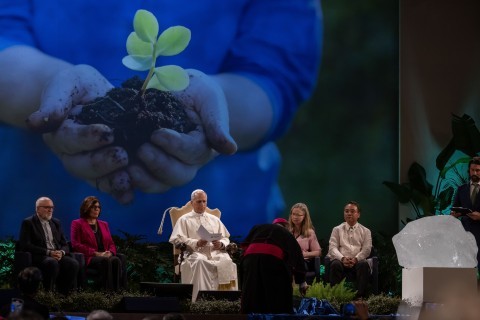
The three-day conference, titled “Raising Hope for Climate Justice,” saw participation from around 500 delegates, including representatives from global governments, faith-based organizations, and NGOs. This diverse group gathered not only to celebrate the accomplishments achieved since the release of Laudato Si’ in 2015 but also to strategize about forming stronger partnerships and taking concrete actions moving forward.
Pope Leo’s message resonated deeply as he stated, “We are one family, with one Father.” He reaffirmed the critical need for collective care for the planet, calling for unity around integral ecology. This theme echoes throughout the heart of his papacy, promoting collaboration across various sectors to address pressing environmental challenges.
Addressing the skepticism surrounding climate change, Pope Leo noted, “some have chosen to deride the increasingly evident signs of climate change,” stressing the need for a paradigm shift in how society views these critical issues. “Everyone in society must put pressure on governments to implement rigorous regulations and controls,” he stated, calling on citizens to engage actively in political processes. This civic engagement is portrayed as vital for mitigating environmental damage.
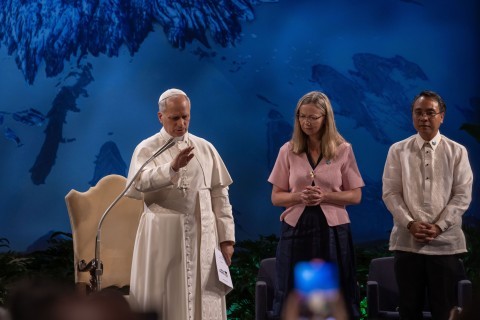
In his address, Pope Leo asked poignant questions to the audience, seeking to provoke a deeper reflection on their roles as stewards of creation. “What must be done now to ensure that caring for our common home does not appear as mere passing trends?” he questioned, urging delegates to recognize the pressing need for transformative action.
He invoked the concept of “ecological conversion,” asserting that a shift must take place from merely collecting data to fostering genuine concern for the environment. “It is only by returning to the heart that a true ecological conversion can occur,” Pope Leo remarked, emphasizing the relevance of these challenges, which include spiritual, social, and political dimensions.
Integral to this ecological vision are the four relationships with God, others, nature, and oneself. Pope Leo posited that nurturing these relationships will enable collective growth in hope, as individuals and communities embody the principles of Laudato Si’.
The Pope’s call resonated with urgency as he expressed hope for the upcoming U.N. climate summits, particularly the 2025 Climate Change Conference in Brazil, urging participants to authentically “listen to the cry of the Earth and the cry of the poor.” His message underscored the importance of youth engagement and inclusive participation in shaping a sustainable future.
Among the notable speakers at the conference was Brazil’s Minister of Environment and Climate Change, Marina Silva, alongside renowned climate advocate, Arnold Schwarzenegger. The former governor of California shared his experiences driving substantive climate action during his tenure, showcasing that responsible environmental policy can coexist with economic prosperity.
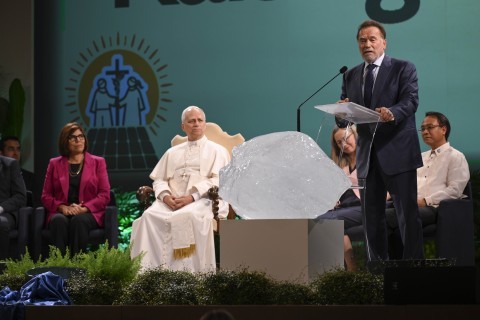
Schwarzenegger’s remarks underscored that aggressive climate initiatives do not undermine economic success; rather, they can fuel growth and innovation. He reassured attendees that the bleak narratives about economic decline linked to environmental legislation were unfounded, citing California’s position as an economic leader while upholding the strictest environmental regulations in the nation.
Encouraging widespread participation, Schwarzenegger urged everyone present to roll up their sleeves and actively contribute to combating climate change, emphasizing that every individual has the power to make a difference.