
Sonam Wangchuk: Leading Voice in India’s Student Protests for Education Reform
As India grapples with renewed protests over educational reforms and the contentious National Eligibility cum Entrance Test (NEET), Sonam Wangchuk has emerged as a prominent figure in the movement. The Ladakh-based engineer and education reformer has become a trusted voice among students and activists who view him as a credible advocate free from mainstream political entanglements.
Wangchuk’s recent participation in an indefinite hunger strike in Delhi, lasting over twenty days, garnered significant media attention. Following a court intervention, he was transferred to a private hospital, highlighting his commitment to the cause and bringing renewed focus to his decades-long work in education, sustainability, and regional development in the Himalayan region.
Early Life and Education
Born in 1966 in Uleytokpo, a remote village in the Leh district, Wangchuk grew up in what is now the Union Territory of Ladakh. His father, Sonam Wangyal, was a politician with the Indian National Congress and served as a minister in the Jammu and Kashmir government. Wangchuk’s early education in Srinagar was marked by challenges, including language barriers and ethnic differences, which left a lasting impact on his perspective regarding education.
In 1977, he moved to New Delhi, where he attended a Kendriya Vidyalaya before pursuing a degree in Mechanical Engineering at the Regional Engineering College in Srinagar, graduating in 1987. He later expanded his expertise with two years of higher studies in Earthen Architecture in France, completing the program in 2011.
Abhijeet Dipke, head of the Cockroach Janta Party (CJP), holds the hand of Sonam Wangchuk, who has been on hunger strike, at Jantar Mandir, on July 18, 2026. (File photo: Reuters)
Unconventional Choices
Instead of following a traditional engineering career path, Wangchuk focused on addressing educational challenges in Ladakh immediately after graduation. In 1988, he founded the Students’ Educational and Cultural Movement of Ladakh (SECMOL), which aimed to tackle the educational deficiencies faced by local students. SECMOL has since become a significant model for alternative education in the region.
Wangchuk is also known for his innovative solutions to local issues. One of his notable inventions is the Ice Stupa, a water-conservation technique tailored for Ladakh’s cold desert climate. This system stores water in the form of towering ice structures during winter, which gradually melt in spring and summer, providing essential water supplies during critical periods. This innovation has gained international recognition and bolstered his reputation as an engineer committed to sustainability.
His contributions have earned him prestigious accolades, including the Ramon Magsaysay Award and the Rolex Award for Enterprise. Wangchuk has also served as an adviser to various governmental and non-governmental organizations focused on Ladakh’s development. To further enhance education in the region, he later established the Himalayan Institute of Alternatives, Ladakh (HIAL), aimed at fostering locally relevant and innovative learning models.
Bollywood Controversy
Wangchuk is perhaps best known to the broader Indian public due to a long-standing debate regarding the Bollywood film 3 Idiots, starring Aamir Khan. Many viewers have speculated that Wangchuk inspired the character of Phunsukh Wangdu, also known as Rancho, an eccentric inventor in the film.
Wangchuk has consistently refuted this claim, noting that the film is a loose adaptation of Chetan Bhagat’s Five Point Someone, which does not feature a character named Phunsukh Wangdu. The controversy resurfaced when Aamir Khan linked Wangchuk’s hunger strike to the film’s protagonist. Although Khan stated he had not met Wangchuk prior to the film’s production, Wangchuk clarified that they had indeed met at an award function beforehand, where he had proposed a different film project focused on Siachen and the challenges faced by its inhabitants. However, that project did not come to fruition.
Khan’s production team had initially intended to shoot a climax sequence at Wangchuk’s school in Ladakh but was denied permission due to the use of plastic materials, leading them to film at a different location. When directly asked if he was the inspiration for Phunsukh Wangdu, Wangchuk stated, “No, I am not Phunsukh Wangdu. I am Sonam Wangchuk. I don’t work in films; I work in real life.”
Campaign for Ladakh and Arrest
In recent years, Wangchuk has increasingly merged his work in education and sustainability with public advocacy. He was arrested in September 2025 during a campaign advocating for full statehood for Ladakh and constitutional protections for indigenous land, culture, and local communities under the Sixth Schedule of the Indian Constitution. Authorities accused him of inciting protests and later pursued allegations regarding funding-rule violations related to his organization.
Following his arrest, Wangchuk was transferred from Leh and detained under the National Security Act in a jail in Rajasthan. He remained in custody for approximately 170 days before being released in March 2026 after a protracted legal battle and intervention by the Supreme Court.
Fight for Education Reforms
Wangchuk’s latest political engagement is linked to the formation of the Cockroach Janata Party (CJP) in May 2026, a youth-led movement aimed at addressing the frustrations of politically disillusioned young people. While not a registered political party, the CJP focuses on issues such as judicial reforms, electoral integrity, media reform, and educational accountability.
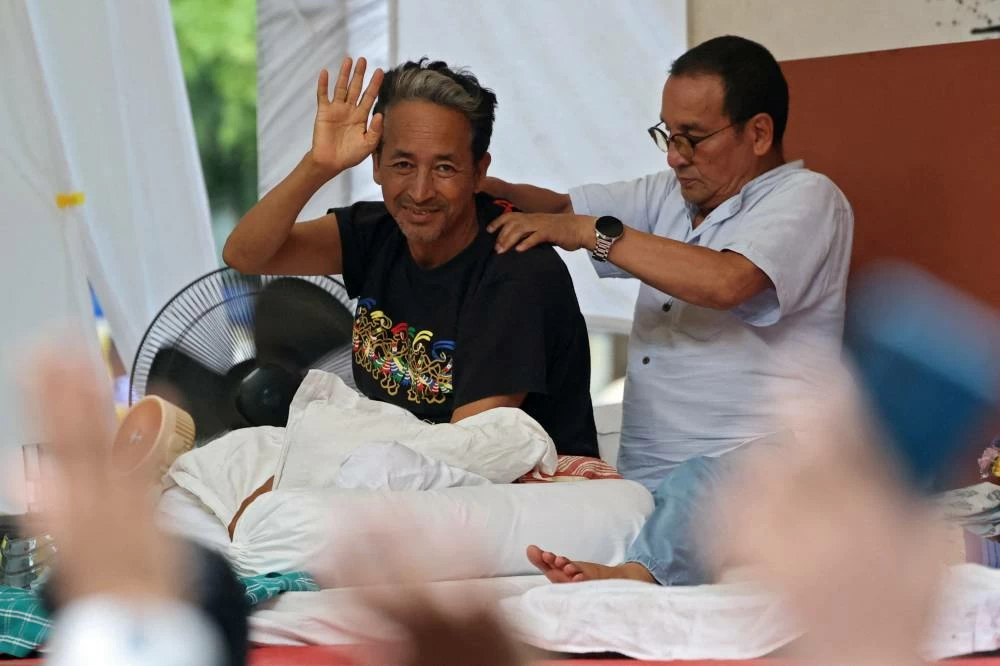
Sonam Wangchuk, an Indian education reformer, who has been on hunger strike, gestures as he receives a back massage during a sit-in protest. (Reuters)
In the wake of the NEET controversy, student organizations and the CJP sought support from respected public figures. Wangchuk, known for his background as an educator and advocate of non-violent protest, became a natural choice. In late June, he joined students at Delhi’s Jantar Mantar protest site, participating in an indefinite hunger strike to demand comprehensive reforms to the examination system and the resignation of the Education Minister.
Wangchuk’s multifaceted contributions to education, environmental innovation, and civic activism have positioned him as a key figure in the current movement for educational reform in India. His reputation as a reformer focused on practical solutions rather than political power continues to resonate with the youth of the nation.
Source: www.emirates247.com
Read all the latest developments and breaking updates in the Latest News section.
Published on 2026-07-22 16:31:00 • By the Editorial Desk